



The Next Act in Learning
As Drama for Schools turns 20, model evolves as students now help co-design curriculum with their teachers to improve learning outcomes
By Esther Robards-Forbes
Seventh graders fan out across the halls and classrooms of Ann Richards School for Young Women Leaders in Austin, ready to teach as part of the school’s second annual Action Through the Arts Festival. Some guide younger students through climate-focused activities they designed themselves. Others explain zines, artwork, performances, virtual reality projects and research f indings created during months of classroom work. Down the hall, another group leads an arts workshop on becoming Texas endangered species ambassadors.
Among the audience are sixth graders, teachers, university researchers and community partners, but the adults are mostly observers. 30
“We offered a one-minute welcome at the top; we did not speak again for 2 ½ hours,” said Katie Dawson, professor in the Department of Theatre and Dance and director of Drama for Schools, a groundbreaking educational program that recently celebrated 20 years of using art to improve educational outcomes for teachers and students.
The festival was the culmination of a yearlong collaboration among students, teachers and researchers using Drama for Schools’ arts-integrated Student Teacher Learning Community model. Along the way, students helped redesign the entire seventh grade curriculum, develop surveys, analyze data and decide what their peers most needed to learn about climate change.
By the end of the day, the school’s dormant Green Team, a student environmental organization, had been revived, sixth graders had been recruited to join it, and a new generation of student leaders was already beginning to take shape.
For Dawson, the festival represented something larger than a successful school project.
It was a glimpse of what education looks like when students are trusted not just as learners, but as collaborators and curriculum designers.
Since its founding at The University of Texas at Austin, Drama for Schools has evolved from a professional development initiative that helped teachers integrate theatre into academic subjects into an internationally recognized research-practice model. Working with educators, artists and increasingly students themselves, the program uses drama-based pedagogy to explore how the arts can make learning more engaging, collaborative and human.
Students teaching other students about a complicated topic such as climate change may seem unusual, but its roots stretch back to the early 2000s, when Dawson was working with public school teachers and saw a disconnect. Thanks to state and federal educational policy, such as No Child Left Behind, students were expected to learn through increasingly rigid instructional models centered around standardized testing. At the same time, Dawson knew from her background in theatre and education that people often learn best through storytelling, play, movement and collaboration.
While many arts integration programs relied on prepackaged lessons or one-time workshops, Drama for Schools took a different approach. Rather than teaching science teachers to become drama teachers, Dawson, working in partnership with educational psychologist Stephanie Cawthon in the College of Fine Arts, focused on training educators to use arts-based strategies that they could adapt to their own students, subjects and classrooms.
The kind of flexibility that Drama for Schools offered allowed it to be adapted to virtually any subject, from literacy to math to history, and it would propel the program from its origin in Texas classrooms to schools around the world.
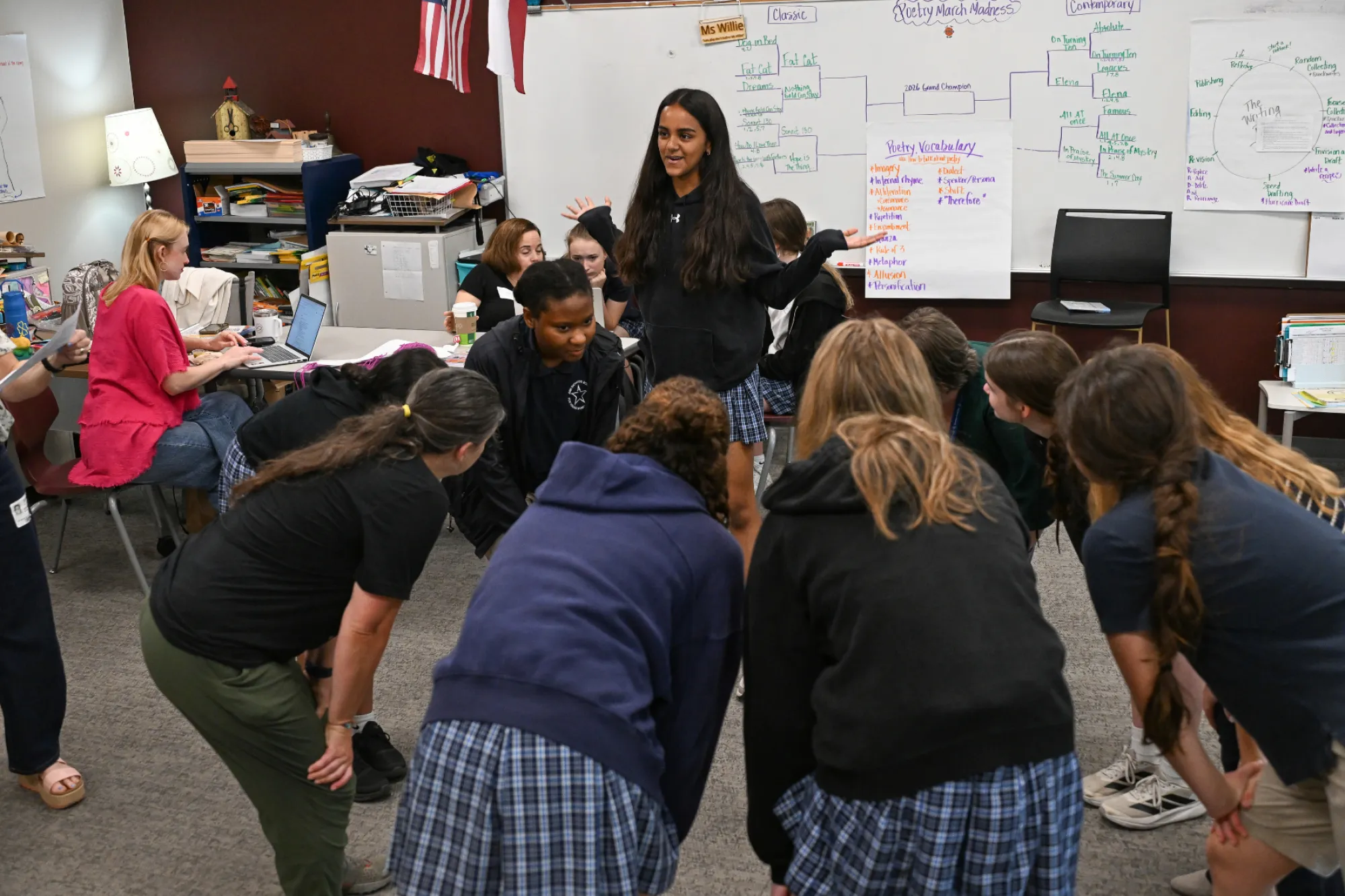
Drama for Schools professional learning coordinator and associate professor of instruction Lara Dossett also notes about the power of the arts in education. “The arts allow us to connect what we think and what we feel in really important ways,” Dossett said. “The arts are inherently multimodal.”
Using arts-based teaching, students aren’t just reading about a subject or listening to a teacher’s lecture. They work together and discuss their ideas. Then they create, embody and express their response.
“If I’m a student, I’m going to remember what that concept means because I absorbed it, I processed it, and I put it in my body,” said Dossett. “I had to understand it in order to express it.”
Danielle Willie, a seventh grade English language arts teacher at Ann Richards, has seen that difference firsthand.
“To embody the learning in that way does help it stick in a different way than just memorizing for a test and then you don’t think about it again,” Willie said.
She points to a phrase frequently used in Drama for Schools: making the invisible visible.
“Taking ideas that are really abstract and making them concrete through movement, it becomes more real,” Willie said.
Drama for Schools started with teaching teachers how to use art in their classrooms, but Dawson and her collaborators noticed something larger happening. Teachers weren’t simply adopting activities. They were redesigning learning. And eventually students began helping redesign it, too. Dawson and her team were there to capture the data, allowing them to publish their research findings that demonstrate how drama-based pedagogy increases teacher effectiveness and improves the quality of student engagement in the K-12 classroom.
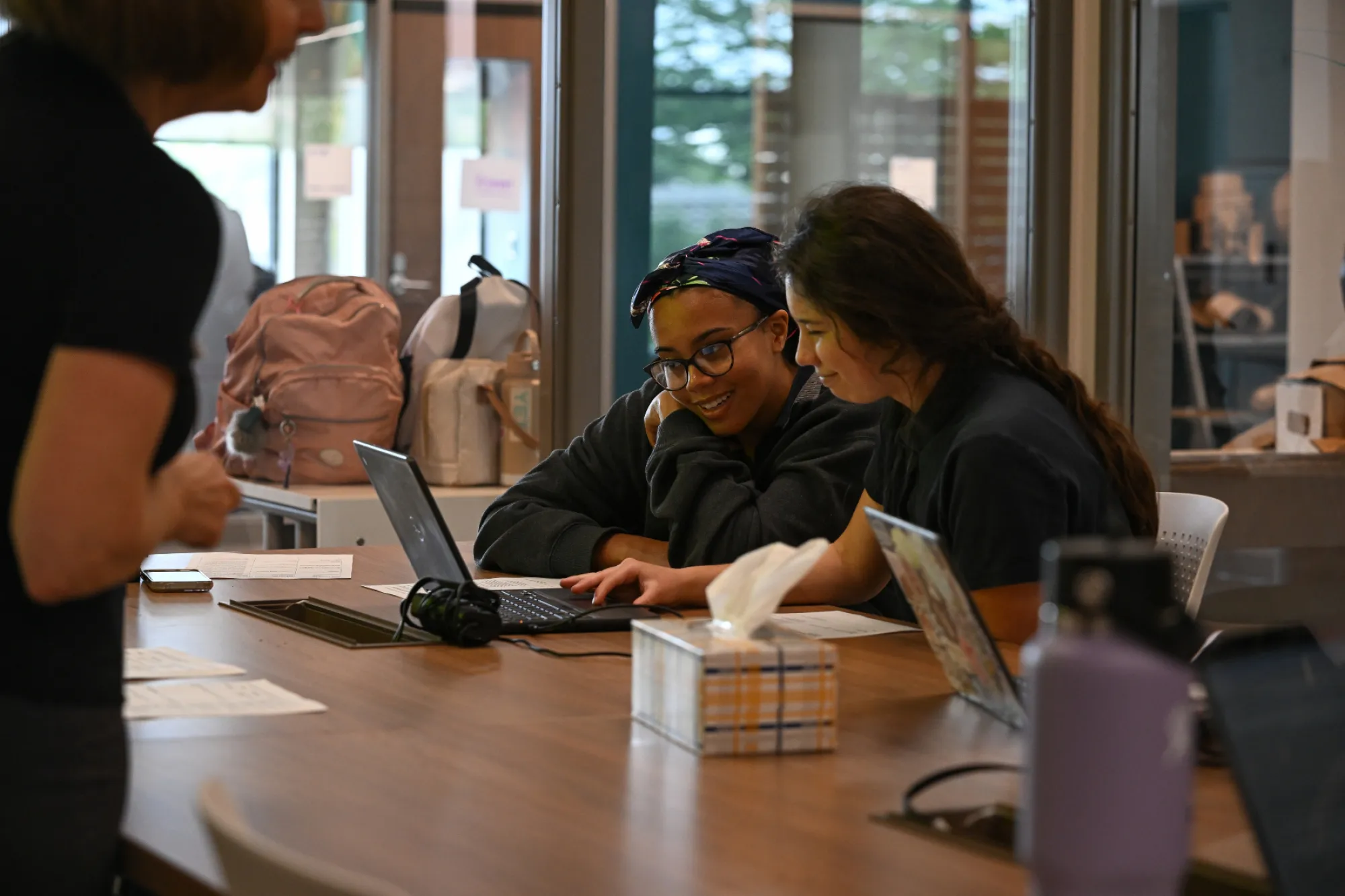
“DFS is grounded in a belief that when teachers know how to integrate the arts into education, they increase their capacity to design and teach for effective learning; they become the teachers they really want to be,” Dawson said.
The educational landscape today looks very different from when the program began. Yet many of the questions that inspired the program remain surprisingly familiar: How do educators keep students engaged? How do they create meaningful learning experiences? And how do they help young people feel connected to each other and the world around them?
Teachers and students are dealing with the lingering effects of COVID-era disruptions, students are disengaged and distracted, teachers struggle with burnout while student mental health is considered a crisis in many areas. Classrooms are increasingly shaped by screens, digital technology and even artificial intelligence, a tool that can generate information on command, but not true understanding.
While technology focuses on how information is delivered, Drama for Schools and its research have focused on how students learn. Through movement, conversation, creativity and collaboration, students become active participants in constructing meaning rather than passive recipients of information.
Willie sees the approach as an antidote to some of the challenges facing students today.
“One challenge that I’ve noticed is getting kids to connect and engage with each other and not with a screen,” Willie said. “AI can write anything for you. It can do anything that you ask, so thinking about why these things really matter is the key.”
She also sees arts-integrated learning as a way to help students be present in the classroom.
“When we’re in our bodies, that’s so mindful,” she said. “But it also helps in building community with each other in ways that are really powerful.”
Whether students are exploring geometry, literature or climate justice, the goal is the same: to help them think critically, collaborate effectively, and see themselves as capable contributors to the world around them.
Over time, Dawson, Dossett and Cawthon began asking a new question: What would happen if students were invited into the school improvement process as partners rather than participants?
One answer emerged through what DFS calls arts-integrated Student Teacher Learning Communities, collaborative groups in which students, teachers, administrators and university partners work together to design, test and improve learning experiences using the arts.
For the climate resilience through the arts project at Ann Richards — which was supported with funding from Planet Texas 2050, UT's interdisciplinary grand challenge focused on climate resilience — students didn’t simply complete assignments; they identified goals, designed the project and shaped the curriculum. During the festival, they taught their peers. They also captured data about the learning that happened, analyzed the data and presented their findings at a major research symposium in May that hosted educators and researchers from across the country and overseas.
Research findings reveal positive shifts in student academic identity, agency, confidence, collaboration and climate literacy, alongside changing understanding across the school about the value of the arts in teaching, student leadership and student voice.
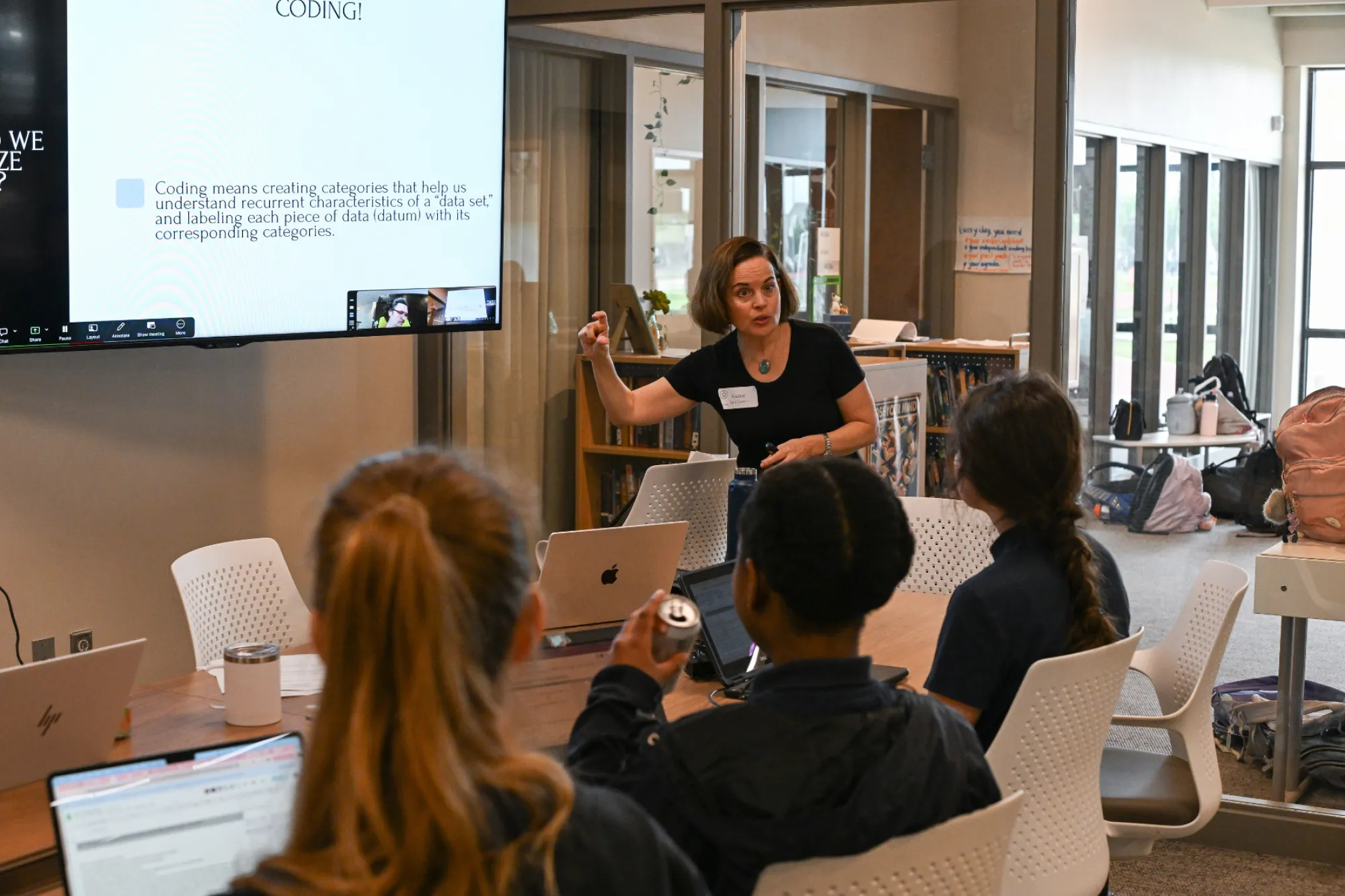
“The students helped design the survey, learned qualitative coding methods, and analyzed results alongside teachers,” Dawson said.
Surveys found that 84% of the seventh-grade participants felt that this project helped them to creatively imagine a new positive future for themselves or others in Austin.
And 96% felt that this project helped them learn some degree of new information about climate change.
When the project began, students were asked to help imagine what a climate resilience through the arts initiative might look like. Dossett recalls that many of the students immediately began generating ideas, while the teachers were less sure, more likely to rule things out as difficult or impossible and worried about logistics.
That moment became an early reminder of one of the program’s core beliefs: Young people often have more insight, creativity and capacity than adults expect.
Willie saw that same dynamic play out while planning the second climate resilience festival. Students who had participated the previous year returned with ideas about how to improve the experience for younger students.
One suggestion was a new activity called Watercolor Conversations, in which pairs of students silently shared a paintbrush while responding to prompts about climate change through color, shape and imagery.
At first, the logistics seemed impossible.
“There was definitely that moment of, ‘There is no way we can have more than 300 students watercoloring at once,’” Willie said. “But we did it.”
The activity became one of the festival’s most memorable experiences and reflected a broader lesson Willie took away from the project.
“Sometimes I need to get out of the way,” she said. “They want to lead, and they’re capable of leading.”
Many educational initiatives are tied to a grant, a champion or a moment. Funding runs out, leadership changes, resources dry up and programs disappear.
Drama for Schools has always pursued a different goal. The objective isn’t just to deliver a successful workshop or curriculum unit. It’s to create lasting change that remains after the facilitators leave.
After a successful first year in the program, teachers and students at Ann Richards repeated the project largely on their own. Teachers adapted the model, students returned to help younger participants, and the work became part of the school’s culture.
“The seventh-grade teaching team at Ann Richards can repeat this project every year because they co-designed and built every aspect of it with us,” Dawson said.
For Willie, continuing the work after the first year was an easy decision.
“It was the most successful and authentic, meaningful project that we had done,” she said. “Of course, why wouldn’t we do it again?”
The success of Drama for Schools isn’t measured solely by the number of workshops delivered or lessons created. It’s measured by what happens after the facilitators leave.
Looking ahead, Dawson, Dossett and Cawthon plan to bring the arts-integrated Student Teacher Learning Communities model to other Texas schools, develop open-source resources, and establish a DFS Research Lab at UT to support future research and partnerships.
Drama for Schools has demonstrated that some of education’s most meaningful innovations emerge not from top-down mandates, but from relationships among teachers, students, artists and communities.
“Our goal is to create a means and method for how to use the arts to create powerful and sustainable changes in education,” Dawson said. “Provide training in the tools and step back.”
The students and teachers who designed the climate resilience festival are already asking what comes next. Some are planning next year’s work. Others are considering how they can contribute to the research.
Perhaps that is Drama for Schools’ most enduring legacy: a generation of students and teachers who see themselves as capable of shaping the future of education.
“We get to be in the room with amazing teachers and students who believe education can be better,” Dawson said. Dossett agreed: “This is why we do it. We know that when we transform ourselves, we begin to transform the world.’”