



Maya for the Masses
Professor David Stuart’s new book brings Maya history to life for non-academic audiences
David Stuart is the David and Linda Schele Professor of Mesoamerican Art and Writing at The University of Texas at Austin. His interests in the traditional cultures of Mesoamerica are wide-ranging, with a primary research focus on the archaeology and epigraphy of ancient Maya civilization. For the past four decades, he has been active in the ongoing decipherment of Maya hieroglyphic writing and in related studies of Maya iconography, religion and political history. Stuart’s early contributions to the decipherment led to a MacArthur Fellowship (1984–1989), and he remains the youngest recipient of that award. His latest book, The Four Heavens (Princeton University Press, 2026), brings to life the cultural and visual splendor of the ancient Maya, drawing on the oldest indigenous texts of the Americas and the latest archaeological discoveries to present an entirely new history of this civilization for non-academic audiences.
Tell me about the genesis of your new book. Why this book right now?
I asked that myself because I didn't plan to write the book. Princeton University Press approached me about five years ago about a new series they were developing in archaeology, and they wanted a book on the Maya. They asked for a grand sweep treatment, “the rise and fall of Maya civilization.” I was not planning to write a book like that and was still in the midst of much more specific academic work. But after I mulled it over, I realized it was needed. There are lots of books on the Maya — my shelf is full of them — but they're very narrowly focused and usually written for other academics. There are a few good general books, but they're more focused on dry archaeology. I thought there was a wonderful opportunity to write a cohesive narrative history of the people, of the dynasties, and the kings and the queens. That didn't really exist.
In fact, when I first got interested in the Maya, there was no history. We didn't know the names of any key players. We didn't know the narratives. We didn't know the politics. And all that changed. It's like studying ancient Greece and not knowing the names of any historical actors — say, looking at Sparta or Corinth or Athens and having no historical frame of reference. They'd be archaeological sites, but largely mysterious.
With the Maya, history came fast. I was lucky enough to be part of the decipherment of the glyphs that led to that, mostly in the ’80s and ’90s, and one of a handful of scholars. Our field is still not huge. There may be 20 of us these days who study Maya hieroglyphs and the ancient narratives. For years we were all overwhelmed with what we had in front of us, and honestly, stepping back to write the larger narrative was hard.
In writing about the past, we often wait for others to write the narratives for us. So, the book was freeing for me in a way, channeling a bunch of facts and first-run interpretations mostly out of my head. One day, I decided to make the family trees of the major dynasties on my office whiteboard. It was all in my head, and I was like, “Wow, there it is!” It revealed to me just how connected the families really were over the centuries.
How much of the book would you say is new research versus translating what you've been writing about for decades?
There are lots of historical details that are well known to people in my field, at least, and a little bit outside of the field. But there is a narrative cohesion to everything that I think is new, showing how these people over here were doing what they were doing because of this going on over here. This is just a first draft in a way of that history, because in 30 or 40 years, people are going to be saying, “What did this guy David Stuart know?”
A lot of the basic history in it is new. I'm giving it my own spin also, which is, I'm sure, going to be hit and miss in the end. But I have some of my own ideas about how Maya civilization developed and how it collapsed. Some of that is based on kind of my own speculative thinking, and some of it on real data. I allowed myself to go there with that and not just be straight-laced about making it a scientific treatise.
You've studied Maya history almost your entire life. What is it about this particular civilization that so captured you and has sustained your career?
Well, I grew up in it. My mom and dad were both writers for National Geographic, and one of my earliest memories is in the jungle in Guatemala looking at a Maya pyramid. When they were there on various assignments, the family went along. I had all these amazing opportunities and incredible luck, to be honest, meeting scholars like Linda Schele and many others who were friends of my parents. It was just a tight community in those years, and they embraced new voices. I was just a kid, and they were like, “Well, you're saying some interesting things. Why don't you come talk at our conference?” In retrospect, it was crazy. I was sitting there debating in my own awkward way with people from Harvard, Yale and UT about the reading of glyphs. I didn’t know what I was getting into, and I had absolutely no sense of academia as a thing. Maybe I still don’t!
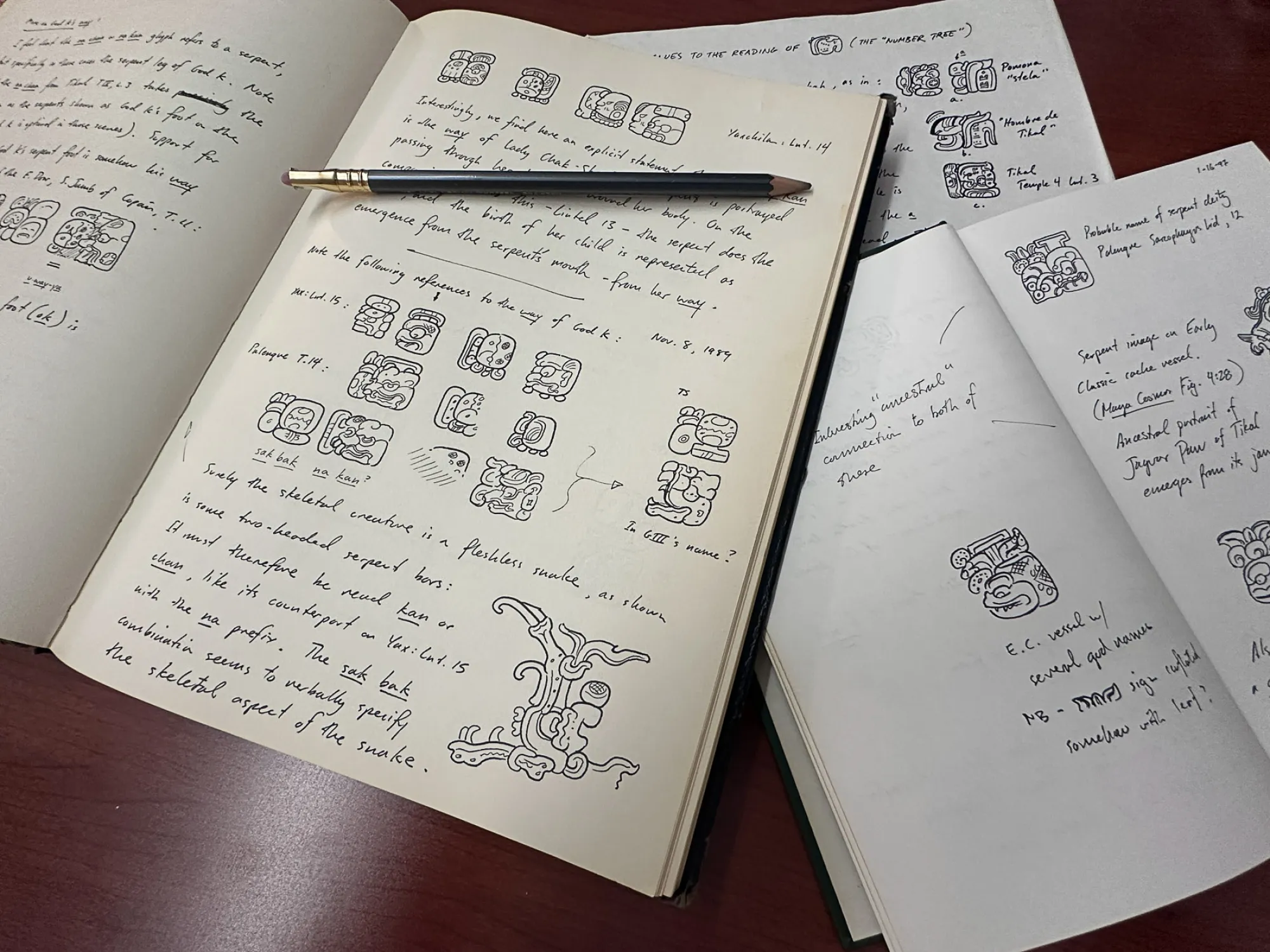
Maya hieroglyphs are so beautiful looking, so enchanting and weird. And in those years, I was into them the way some kids later got into Pokémon cards or something. I wanted to collect them all and figure them out.
You're known for a lot of the breakthroughs that you've had in deciphering Maya glyphs. Is there an example or a particular piece of decoding that you've done that shows what that can do for the area of research and what can make it known to other historians?
There are small and big examples of this. One of the first things I ever did — this was in the early ’80s — I deciphered the glyph for chocolate. Kakaw (our “cacao”) was the word in Mayan. And it turned out to be all over these very fancily painted vases that were coming out of Maya tombs, and they were in museums and archaeological sites. That really opened up this world of the importance of food and feasting in royal courts and parties. They were so into chocolate, and that was just that one thing just popped out.
What can modern society learn from studying an ancient civilization like the Maya?
Well, there are a couple ways of answering that. One is we now have the oldest written history in the Americas, and that's important. It's over 1,000 years before any Spanish ships appeared on the horizon, completely independent of any traditions in Asia or Europe or anywhere else. It’s a history that is not widely known, despite how important it should be to anchor the story of the Americas. It's still not taught in high schools or in middle schools in the U.S. or in Mexico. Amazingly, the kids who are Maya, living in Yucatán or in Guatemala, aren’t ever taught much of their ancient history. Many of us are working to bridge these gaps, expand awareness and fight against the structure of education in local and national levels. I hope the book can spread the word.
The other thing is, as I was writing the book, inevitably it was really about the dynamics of these cultures and how they develop and how they reach these kinds of endpoints. I had to address the supposed “disappearance” in the Maya, which I am often asked about. It's a complicated issue because there's a lot we still don't understand about the societal collapse that happened around A.D. 800, but nobody disappeared. They abandoned their cities, and this is not uncommon in the ancient world. This is why we find archaeological sites, because people choose to walk away from them.
Clearly, many Maya cities and communities experienced a crisis around that time. A lot of it had to do with environment. A lot of it had to do with warfare. A lot of it had to do with other factors. And there were all these tipping points where — and this is what I try to emphasize in my book — the Maya decided to leave, having a good deal of agency in doing so. It's not like they were being dragged away or even being killed off. I see the Maya people as voting with their feet, rejecting a long-lived system. The royal courts were collapsing because they were all fighting each other, and I think there came a point when many non-elites just became fed up. People moved on quickly.
This is why the history of those courts wasn't kept and remembered. When the cities were abandoned, their histories were forgotten. So much so that by the time the Spanish arrived 700 years later, Maya history seems short-lived and not very deep. It doesn't go back to this other stuff we read about in the more ancient texts. So, the great historical rupture was created by both the Maya and by the Spanish. It's not just the Spanish coming in and burning books, which they did for sure. Maya history was always very local and family-focused, so by the time of the Spanish conquest, there were other, more immediate concerns.