



Dean's Letter: New works that engage archives and history
This issue of Arts Next engages with future-thinking innovation from our college (as we always do), but there’s also a strong thread highlighting how our rigorous, research-based approach to what we do touches history in significant ways. The issue highlights multiple projects that show how artworks engage in archival practices and how contemporary scholarship in the arts makes history relevant to our present moment.
Landmarks, the public art program at The University of Texas at Austin, unveiled its latest work in April: a stunning glass façade on the George I. Sánchez Building by artist Howardena Pindell titled Autobiography: Circles. Pindell has used circles in her work throughout her career as a reference to a childhood memory of red circles marking dishes for Black customers during segregation. This new work — her first commission in Texas — brings together these circle motifs and other visual elements from across Pindell’s career. Some of the circles are actual scans of her earlier works that have been combined into this new installation. Pindell’s work pursues, as the title suggests, the artist’s autobiography through a layered materiality that renders historical experience relevant and urgent to the present moment.
Two stories in this issue explore how studying traditions with deep histories (African dance and church music, in these cases) allows students to both embody history and animate it into the contemporary moment. In the story “Wired for Rhythm,” Dance Assistant Professor Sinclair Emoghene looks at embodied techniques and how he codifies them through technological innovation. “Sacred Calling, Serious Career” explores how the Butler School of Music has long been a talent pipeline for musicians, choir directors and music directors for churches across the state. Both of these stories show how critical it is for us train our students in the history of these disciplines to enable to them to carry forth traditions in the historical sense, while innovating on stages and places of worship with their creativity.
Our commencement speaker this year was alumna and Tony Award-nominated playwright Kimberly Belflower. Her most recent play, John Proctor is the Villain, is an adaptation of Arthur Miller’s The Crucible, with an eye toward contemporary audiences. She mines this iconic text in our theatrical history (itself a reflection on an earlier historical period) in her work to add relevance and understanding of the text and the social world it critiques, in past and present contexts. Belflower’s play has been a hit with audiences and critics alike with its run on Broadway. It transferred to London during the spring and is being adapted for film, with Tina Fey as a producer.
On the scholarship front, Art History Professor David Stuart published a new book written for non-academic audiences to share a history of the Maya. In a Q&A in this issue, Stuart talks about the importance of sharing this history that’s been unknowable for centuries and that has only been uncovered and documented during the past few decades.
Each of these examples shows how art engages history and teaches the lessons of history with new perspectives and framing. In the College of Fine Arts, we pride ourselves in serving as keepers of our cultural inheritance even as we innovate. These dual pursuits ensure the future of the arts is anchored in history while sustaining bold practices that ready our students for their creative futures.
Sincerely,

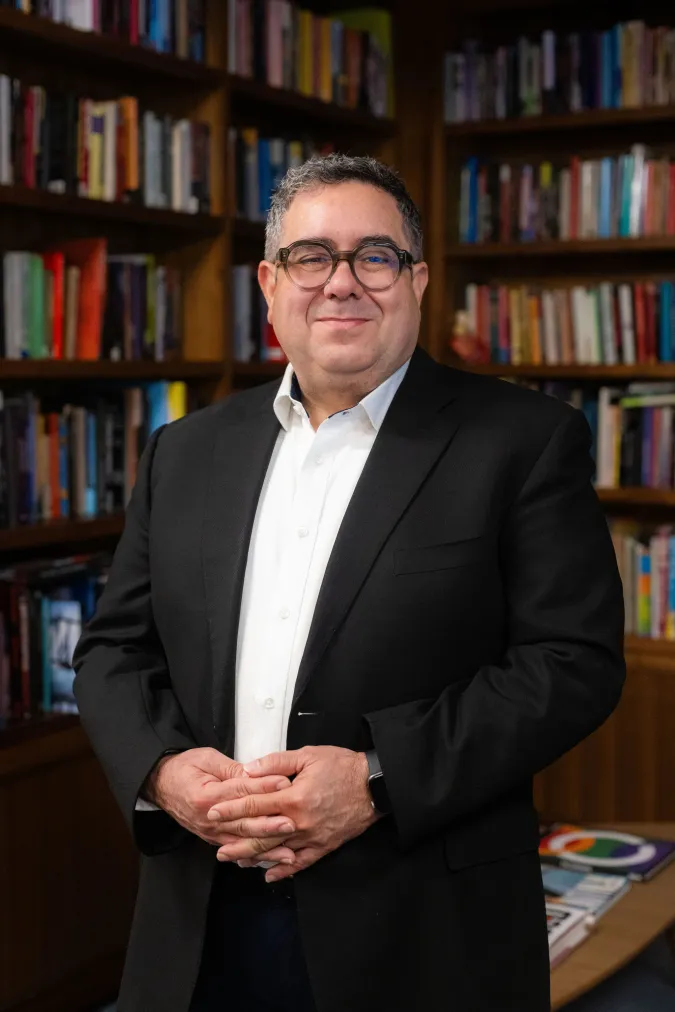
Ramón H. Rivera-Servera
Dean, College of Fine Arts